

Algorithm-Driven Breakthrough: How Infox CRPA Tackles Intense Electronic Warfare Interference Challenges


2026-01-14 14:04
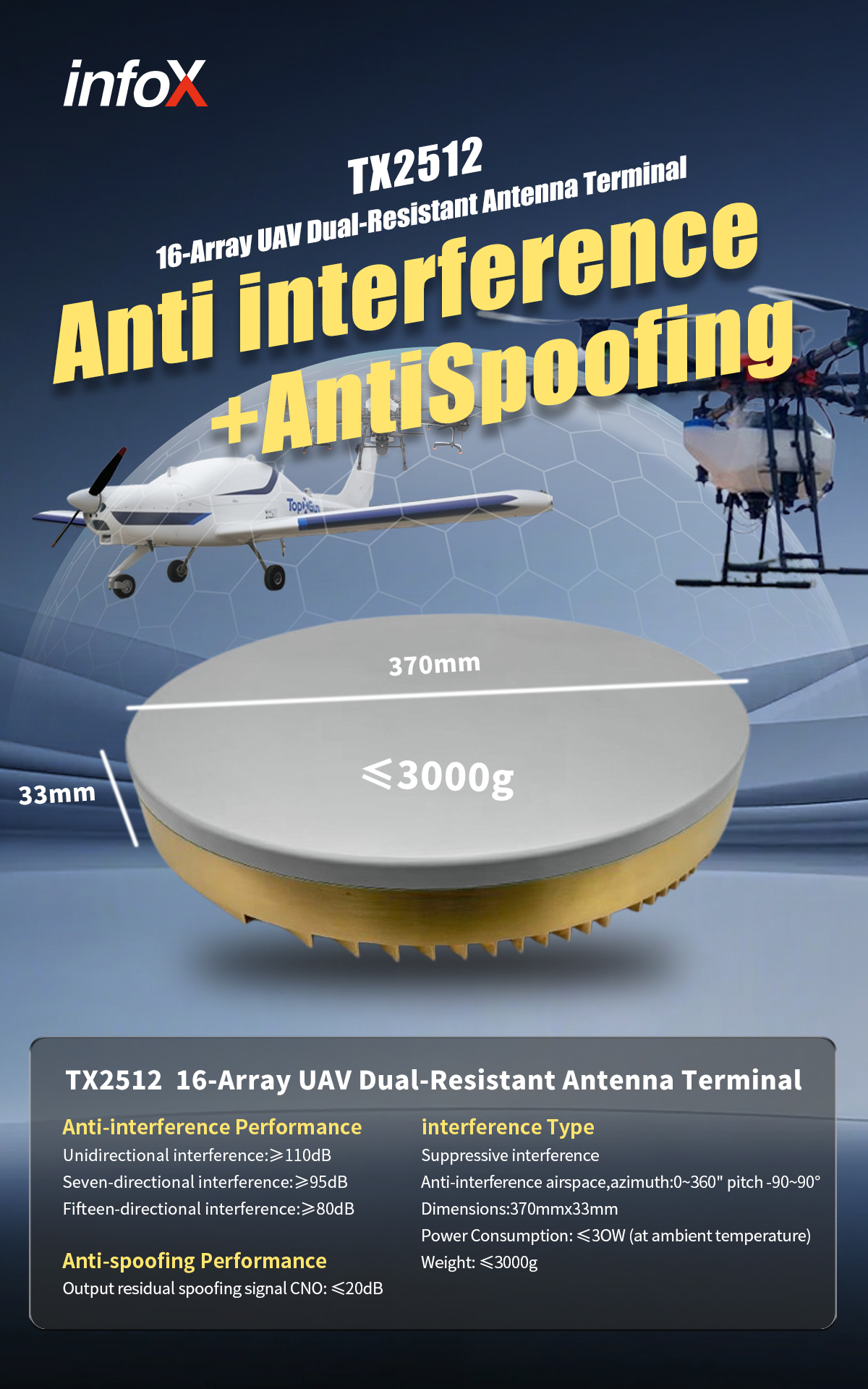
In modern electronic warfare (EW), Global Navigation Satellite System (GNSS) signals confront unprecedented dual threats: suppression interference and spoofing attacks. Barrage interference and spot interference can directly overwhelm satellite signals, while spoofing technologies such as pseudolite networking fabricate false navigation data—leaving drones reliant on GNSS vulnerable to "mission failure the moment signals are lost." Anti-interference technology has thus become a core cornerstone of EW operations. As limitations of traditional solutions grow increasingly prominent, algorithm-driven Controlled Reception Pattern Antennas (CRPA) have emerged as a game-changing alternative. By deeply integrating advanced algorithms with CRPA hardware, Infox has achieved dual capabilities of anti-interference and anti-spoofing, forging a robust defensive shield for drone GNSS signals in extreme electromagnetic environments.
Limitations of Traditional Anti-Interference: Brute Force vs. Sophisticated Attacks
Faced with evolving and increasingly sophisticated interference threats, traditional anti-interference solutions exhibit glaring shortcomings:
- Power amplification relies on a "brute-force" approach: not only does it incur excessive power consumption, but it also amplifies spoofing signals concurrently. This method fails completely when interference power exceeds the critical "burn-through threshold."
- Traditional full-array antennas adopt fixed beamforming logic, only passively shielding pre-defined interference directions. Lacking intrinsic signal recognition capabilities, they are powerless against spoofing attacks—functioning merely as "physical filters" rather than intelligent defensive systems.
Algorithm-Driven Breakthrough: Infox CRPA’s "Dual Anti-interference Engines"
To address these inherent flaws of traditional solutions, Infox has integrated cutting-edge algorithms into the core of its CRPA system, developing a "dynamic anti-interference + intelligent anti-spoofing" architecture that transforms passive defense into active signal cognition:
- Anti-interference capability: By leveraging advanced algorithmic integration, the system conducts real-time analysis of signal characteristics, accurately locates interference sources, and dynamically adjusts beam direction. It focuses gain on valid satellite signals while forming precise "signal nulls" in interference directions, eliminating power waste and response latency.
- Anti-spoofing capability: Utilizing a dedicated algorithmic framework, the system extracts unique, stable features of authentic GNSS signals—characterized by consistent carrier phases and code rate cycles. This enables it to rapidly identify spoofing signals, which typically exhibit abnormal phase jumps or irregular code patterns.
This "hardware array + algorithmic brain" architecture empowers Infox CRPA to maintain stable GNSS signal reception even in extreme interference environments, outperforming traditional solutions by a significant margin in both reliability and efficiency.
Drone Application Scenarios: A Reliable Signal Anchor in Extreme Environments
In practical drone operations, the algorithmic advantages of Infox CRPA are fully demonstrated across diverse high-stress scenarios:
- Against portable ground jammers: Traditional CRPA systems often lose signal lock, while Infox’s solution rapidly evades interference directions to sustain continuous satellite connectivity, ensuring uninterrupted mission execution.
- In complex low-altitude environments: Its proprietary multipath suppression algorithm effectively filters out signal reflections from buildings and industrial electromagnetic noise, guaranteeing precise drone navigation along preset routes.
- In extreme interference environments: It successfully resists high-power barrage interference and decoy-based spoofing attacks, breaking through the long-standing operational bottleneck where drones "fail instantly upon interference exposure."
Core Technology: Intelligent Signal Filtering—the Essence of Next-Gen Anti-interference
The paradigm of anti-interference competition has shifted from "hardware power rivalry" to "algorithmic recognition precision." Traditional solutions are inherently incapable of achieving "intelligent signal filtering," whereas Infox’s core breakthrough lies in endowing CRPA with "signal judgment capabilities" through advanced algorithms—enabling it to accurately capture authentic GNSS signals amid chaotic electromagnetic environments.
This technical pathway aligns with the broader trend of "smart countermeasures" in modern electronic warfare, as well as the critical requirements of drones for "low power consumption and high reliability." Amid the increasingly fierce EW landscape, Infox’s algorithm-centric CRPA technology redefines the standards for drone anti-interference performance, constructing an "intelligent defensive line" for GNSS signals in the harshest operational environments.
Get A Quote
We will contact you within one working day. Please pay attention to your whatsapp.
Contact Us
Add.: B-1408, Zhongdian Great Wall Building, No. 3, Kefa Road, Science and Technology Park Community, Yuehai Street, Nanshan District, Shenzhen,China